I received an email from my law school this evening reporting that my old contracts and commercial paper professor had just died. In an irony too strong to ignore, this email was initially sorted by my spam filter into my junk mail folder, where everything from this particular academic institution lands.
Professor Farnsworth performed what may have been the only act of kindness toward me that I experienced in three years of law school by writing a fine letter of recommendation for my judicial clerkship applications. The rest, as they say, is history. Without that single act of kindness, leading to my clerkship, who knows where I'd be?
Amazingly enough, he was on the faculty for fifty years, and was full-time faculty up to the day he died. He still had the same secretary that he did in 1981. I am sorry to report that my generation of students regarded him as a pompous jerk. As one of his squadron of research assistants I got to know him better than I did my other professors; he was quite funny in private, but I accepted more or less the popular belief that he was, in public, a stuffed shirt. It is only as I look at his list of credentials, and reflect on his demeanor, that looking back I regard him as simply assured, rather than pompous. I misjudged him owing to my own lack of experience at the time. He saw me far more clearly than I saw him.
The moral of this story? Look back sooner.
1.31.2005


1.30.2005
i'll take three, please
From Jerry Lawson by way of various other people comes word of a Chicago law school's access-to-justice program with components such as the "HonorInsider" providing information about local judges, and a "Digital Sheriff" (the imagination reels).
I was disappointed that the original article didn't give more details on the Logic Learner, billed as a module that "teaches litigants how to construct consistent arguments." I want to order several: one to install at my local courthouse, one to install at my local bar association for the edification of my learned colleagues and myself, and one to install on my home computer for my children's use.
I was disappointed that the original article didn't give more details on the Logic Learner, billed as a module that "teaches litigants how to construct consistent arguments." I want to order several: one to install at my local courthouse, one to install at my local bar association for the edification of my learned colleagues and myself, and one to install on my home computer for my children's use.
1.28.2005
pozner and dodd
God bless 'em, they have a website now, although close inspection suggests that this is simply a component site of the Borg. I learned more about the effective presentation of evidence from these gents' book, cassette tapes, and video seminar than I learned in three years at an Ivy League law school. This probably makes me the closest thing to a Pozner and Dodd groupie that they will ever have.
Such is my enthusiasm for them that I bought the new edition of their book as soon as it came out, even though they appear to have only the vaguest idea of how computers could be used to aid in the mastery of the evidence that is at the heart of their method. Computers in litigation aren't just about scanning a gazillion documents in some mondo class action lawsuit or something. I've got an outlining function in my practice management tools that is extremely handy for linking lists to sublists, which is what "page" preparation for the "chapter" method is all about.
Moreover, with the price of technology plummeting, I don't think scanning your discovery is just for the big boys now. I am handling a case now with about five thousand pages of financial documentation, not horrendously complex, but filling three banker's boxes. It's a pain to be digging through all the time as I get ready for trial. These docs were also copied and Bates-numbered in the order in which the client maintained them, which was not, you understand, a logical order. But that's another rant for another day. Sigh.
Okay, okay, I know the links above don't really describe page preparation and the chapter method. A "page" is a line of questions with the admission of a single fact as their goal. A "chapter" is a series of pages, that is, facts, that make a single point. Just go read the book. I can't do it justice unless I retype the whole damn thing here, and this is a book that is worth study. Even if they use their computers as paperweights.
Such is my enthusiasm for them that I bought the new edition of their book as soon as it came out, even though they appear to have only the vaguest idea of how computers could be used to aid in the mastery of the evidence that is at the heart of their method. Computers in litigation aren't just about scanning a gazillion documents in some mondo class action lawsuit or something. I've got an outlining function in my practice management tools that is extremely handy for linking lists to sublists, which is what "page" preparation for the "chapter" method is all about.
Moreover, with the price of technology plummeting, I don't think scanning your discovery is just for the big boys now. I am handling a case now with about five thousand pages of financial documentation, not horrendously complex, but filling three banker's boxes. It's a pain to be digging through all the time as I get ready for trial. These docs were also copied and Bates-numbered in the order in which the client maintained them, which was not, you understand, a logical order. But that's another rant for another day. Sigh.
Okay, okay, I know the links above don't really describe page preparation and the chapter method. A "page" is a line of questions with the admission of a single fact as their goal. A "chapter" is a series of pages, that is, facts, that make a single point. Just go read the book. I can't do it justice unless I retype the whole damn thing here, and this is a book that is worth study. Even if they use their computers as paperweights.
1.27.2005

can ascap be far behind?
Evan Schaeffer's overdub with material of his own composition of the Legal Underground Word of the Week: Replevin has made it onto Kevin Heller's Tech Law Advisor. If you apply Moore's Law to Andy Warhol, that means I should be famous for . . . fifteen seconds.
unaware and naive
Thus the Pew Internet and American Life Project describes search engine users:
"Internet users are extremely positive about search engines and the experiences they have when searching the internet. But these same satisfied internet users are generally unsophisticated about why and how they use search engines. They are also strikingly unaware of how search engines operate and how they present their results. "
Well, in that case, kids, let's work on googling better.
Then again, perhaps deep web research is called for.
"Internet users are extremely positive about search engines and the experiences they have when searching the internet. But these same satisfied internet users are generally unsophisticated about why and how they use search engines. They are also strikingly unaware of how search engines operate and how they present their results. "
Well, in that case, kids, let's work on googling better.
Then again, perhaps deep web research is called for.
but let's keep this statute
Improper conduct by certain justices
"It shall be a misdemeanor for any judge or justice of any court not of record, during the hearing of any cause or proceeding therein, to address any person in his [sic] presence in unfit, unseemly or improper language." (emphasis added)
Enacted in 1911, never repealed.
"It shall be a misdemeanor for any judge or justice of any court not of record, during the hearing of any cause or proceeding therein, to address any person in his [sic] presence in unfit, unseemly or improper language." (emphasis added)
Enacted in 1911, never repealed.
1.26.2005
the slander of a woman
Most of the laws in Washington state are, let's face it, pretty dull. The state statutory scheme is not much more than a century old, so there hasn't been the time to accrue the crenellations of, say, Massachusetts.
So imagine my delight to discover today to find that the crime of slander of woman is still on the books in my adopted state. Not surprisingly, the publication rule generally necessary to prove damages for slander is a necessary element of the crime as well. The last, in fact the only reported decision addressing this statute is State v. Paysse, decided in 1914. Also not surprisingly, there is a bill in the Legislature this year to repeal the Slander of Woman Act.
Despite my relish for the archaic in law, however, I think it's best for this law to be put to rest (although why on earth anyone in the legislature is fretting about this when the entire system of elections appears to be broken is beyond me) . First of all, this law specifically offers no protection to "common prostitutes"; the logical end to that line of thinking is Gary Ridgway. Second, I don't like the idea that our law preserves a notion that a woman's primary asset is a public perception of her sexual conformity. When reputation matters in today's world, it matters equally to both genders, and sexual integrity only a part of the larger whole.
So imagine my delight to discover today to find that the crime of slander of woman is still on the books in my adopted state. Not surprisingly, the publication rule generally necessary to prove damages for slander is a necessary element of the crime as well. The last, in fact the only reported decision addressing this statute is State v. Paysse, decided in 1914. Also not surprisingly, there is a bill in the Legislature this year to repeal the Slander of Woman Act.
Despite my relish for the archaic in law, however, I think it's best for this law to be put to rest (although why on earth anyone in the legislature is fretting about this when the entire system of elections appears to be broken is beyond me) . First of all, this law specifically offers no protection to "common prostitutes"; the logical end to that line of thinking is Gary Ridgway. Second, I don't like the idea that our law preserves a notion that a woman's primary asset is a public perception of her sexual conformity. When reputation matters in today's world, it matters equally to both genders, and sexual integrity only a part of the larger whole.
captivated
My current building keeps embedding high-tech computer screens in the walls.
I take three elevators to work every morning (shades of the late lamented World Trade Center near my old firm in New York City). Garage elevator to lobby, lobby to 40th floor "sky lobby," sky lobby to my office. When I reach the lobby, the first monitor shows me a schematic of the traffic. Fairly uninteresting when I'm coming from the garage, of course, but useful when I 'm going home.
The latest addition to Elevator Madness, however, is screens in the main elevators with mixed ads and news that cycle through like the ads in movie theatres. It's seductive in a way. On the right of the elevator is the date and time in green letters, while on the left I can contemplate the deeper implications of the factoid that Julia Roberts is buying land from Donald Rumsfeld. Why does my elevator think I need to know this? Is this why things are so screwed up in the Middle East? Is Rummy selling land to anyone else? My God, this is even worse than programmable elevator messages.
Appropriately enough, the company providing content, and I use that term very loosely, to these screens is called Captivate Network. When the Revolution comes, they' ll be the second to go (I figure I'll be the first, for mouthing off so much).
I take three elevators to work every morning (shades of the late lamented World Trade Center near my old firm in New York City). Garage elevator to lobby, lobby to 40th floor "sky lobby," sky lobby to my office. When I reach the lobby, the first monitor shows me a schematic of the traffic. Fairly uninteresting when I'm coming from the garage, of course, but useful when I 'm going home.
The latest addition to Elevator Madness, however, is screens in the main elevators with mixed ads and news that cycle through like the ads in movie theatres. It's seductive in a way. On the right of the elevator is the date and time in green letters, while on the left I can contemplate the deeper implications of the factoid that Julia Roberts is buying land from Donald Rumsfeld. Why does my elevator think I need to know this? Is this why things are so screwed up in the Middle East? Is Rummy selling land to anyone else? My God, this is even worse than programmable elevator messages.
Appropriately enough, the company providing content, and I use that term very loosely, to these screens is called Captivate Network. When the Revolution comes, they' ll be the second to go (I figure I'll be the first, for mouthing off so much).
1.25.2005
from my inbox
Random mail in my inbox this morning: a certain unnamed CLE sponsor is presenting an entire day on "The Mold Challenge in Washington."
This is a subject about which I have discovered I am terribly out-of-date. I had no idea. There is clearly no time to lose.
I can earn six hours of CLE credit, and, should I want it, credit for something called "industrial hygiene," which sounds suspiciously like scrubbing factory toilets, but isn't. Snacks (blue cheese, perhaps?) and refreshments will be provided during discussion of the science behind the mold problem, the different causes and types of mold and their health ramifications, the types of claims that can be brought as a result of mold infestations, the present state of mold litigation, and devising an "action plan" for handling a water intrusion and mold infestation scenario.
But where's the controversy? After all, "some health effects from mold exposure remain controversial because of the potentially significant consequences; yet crucial and legitimate scientific questions remain unanswered. Our incomplete knowledge of noninfectious health effects related to mold exposure is due to limited research support and lack of documented health effects in the context of well-defined exposures. "
Yeah. Let's debate mold, or at least vote for more funding for it.
This is a subject about which I have discovered I am terribly out-of-date. I had no idea. There is clearly no time to lose.
I can earn six hours of CLE credit, and, should I want it, credit for something called "industrial hygiene," which sounds suspiciously like scrubbing factory toilets, but isn't. Snacks (blue cheese, perhaps?) and refreshments will be provided during discussion of the science behind the mold problem, the different causes and types of mold and their health ramifications, the types of claims that can be brought as a result of mold infestations, the present state of mold litigation, and devising an "action plan" for handling a water intrusion and mold infestation scenario.
But where's the controversy? After all, "some health effects from mold exposure remain controversial because of the potentially significant consequences; yet crucial and legitimate scientific questions remain unanswered. Our incomplete knowledge of noninfectious health effects related to mold exposure is due to limited research support and lack of documented health effects in the context of well-defined exposures. "
Yeah. Let's debate mold, or at least vote for more funding for it.
1.20.2005
commas, tabs, and slashes
And if that title has you thinking "Lawyers, Guns, and Money" you have identified its scansion.
I have a document. It is a Word document. It is 150 pages long, single-spaced. (You know where this is leading can't be good). This document is an index of sorts, and has been around for some years. It has a number of different fonts and colors in it.
Now, to my way of thinking, this document shouldn't be a Word document. This document should be, oh, an Access database.
I saved this document as a text document to strip out what I can of the formatting that ails it. Now, I want to ship the contents of the document to Access (which is usually not the direction that data goes with Access and Word, I admit). Even I know that the document should be comma-delimited or tab-delimited so that the data will pigeonhole itself in the db that I just created to receive it.
Now, the original author of this document, PBUH, in his or her exuberance, liberally sprinkled this document with a number of commas AND tabs. AND slashes where there should be a delimiting mark, comma or tab, pick one. AND slashes as well where there must not be a delimiting mark of any sort, so I can't do a global search-and-replace on the slashes.
I speculate that this is because no one thought enough about the function of the original document when it was created to understand that the information in the document was a database, and not simple text.
And that is why I am still working at 11 p.m. thinking evil thoughts about the original author of this document.
I have a document. It is a Word document. It is 150 pages long, single-spaced. (You know where this is leading can't be good). This document is an index of sorts, and has been around for some years. It has a number of different fonts and colors in it.
Now, to my way of thinking, this document shouldn't be a Word document. This document should be, oh, an Access database.
I saved this document as a text document to strip out what I can of the formatting that ails it. Now, I want to ship the contents of the document to Access (which is usually not the direction that data goes with Access and Word, I admit). Even I know that the document should be comma-delimited or tab-delimited so that the data will pigeonhole itself in the db that I just created to receive it.
Now, the original author of this document, PBUH, in his or her exuberance, liberally sprinkled this document with a number of commas AND tabs. AND slashes where there should be a delimiting mark, comma or tab, pick one. AND slashes as well where there must not be a delimiting mark of any sort, so I can't do a global search-and-replace on the slashes.
I speculate that this is because no one thought enough about the function of the original document when it was created to understand that the information in the document was a database, and not simple text.
And that is why I am still working at 11 p.m. thinking evil thoughts about the original author of this document.
1.19.2005
the land that time forgot
When I first hung out my shingle in 1998, there was FindLaw. Well, there still is Findlaw/Thomson/West, but in 1998, FindLaw offered free websites for lawyers. They didn't police it very well, so various advocacy organizations and paralegal services could be found in the index to sites. The templates were quite limited, but there were certain ways that you could jimmie them around to get a bunch of content into the site, especially if you know a little HTML. I wasn't really interested in graphics anyway, just text. Since law is certainly an area where content is king, I built a quite useful and respectable site for a sole practitioner.
In 1999, or so I judge by the dated graphics and the copyright notice on the control panel page, Findlaw stopped handing out little corners of the Internet free for the asking, probably at the time of one of their mergers with--or into--bigger and bigger fish. I remember cynically thinking, when they announced that they weren't handing out new sites, and were offering paid site design, that my little free site was not long for this (virtual) world.
By April 2003, I was in the process of designing a more ambitious site, having outgrown FindLaw in the same way I outgrew my first database program, when I had the opportunity to join a larger firm, which meant eliminating the content of my old site. Although I have screen shots of every change in content that I made in that site over the years (a New York state ethics requirement), it pained me to take it down. I didn't want to eliminate it completely because, well, because.
Now here's the funny thing. It is now 2005 and my little ghost of a site is still here. And on a page that contains a "copyright 2005" statement, FindLaw says: "Currently, FindLaw is not offering free Firms Online web sites. However, we will continue to host existing web sites." And so my dusty little site still bravely offers my updated resume to the the world, where prospective clients stumble upon it when they google me (in fact . . . I apparently have some current clients who google me, or read my blog, from time to time. Guys. I know who you are). Who would have thought that electrons could be so persistent?
In 1999, or so I judge by the dated graphics and the copyright notice on the control panel page, Findlaw stopped handing out little corners of the Internet free for the asking, probably at the time of one of their mergers with--or into--bigger and bigger fish. I remember cynically thinking, when they announced that they weren't handing out new sites, and were offering paid site design, that my little free site was not long for this (virtual) world.
By April 2003, I was in the process of designing a more ambitious site, having outgrown FindLaw in the same way I outgrew my first database program, when I had the opportunity to join a larger firm, which meant eliminating the content of my old site. Although I have screen shots of every change in content that I made in that site over the years (a New York state ethics requirement), it pained me to take it down. I didn't want to eliminate it completely because, well, because.
Now here's the funny thing. It is now 2005 and my little ghost of a site is still here. And on a page that contains a "copyright 2005" statement, FindLaw says: "Currently, FindLaw is not offering free Firms Online web sites. However, we will continue to host existing web sites." And so my dusty little site still bravely offers my updated resume to the the world, where prospective clients stumble upon it when they google me (in fact . . . I apparently have some current clients who google me, or read my blog, from time to time. Guys. I know who you are). Who would have thought that electrons could be so persistent?
here's a pretty fishy

Another pic courtesy of my law partner.
Her comment? "Coolness. Now get back to work." Is this the time to mention that this same partner amuses herself by deleting and restoring the software on her Blackberry in her spare moments? I thought not.
1.18.2005
how very . . . circumspect
After discovering that my law school alma mater did not acknowledge alumni/alumnae blogs, I took a look at what the students there are doing. As usual I found my hope for the profession in its future practitioners. As it turns out, one blogger maintains a blogroll of law students at the school, which, as an alum, I sort of invited myself into last week. I note that I was carefully described as "a reasonable glimpse of the future awaiting some of us." Now if that isn't a delightfully ambiguous comment, I don't know what is. Hard to say whether I'm Dorian Gray or the picture in the attic.
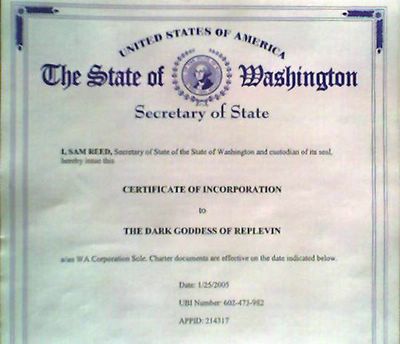
An aside. What is it about law and the Internet that brings out delusions of Satanic grandeur in us all? The above-referenced blog is called "Three Years of Hell to Become the Devil," I style myself the Dark Goddess of Replevin, and one of my friends posts to a mailing list as the Daemon Empress.
Another aside to clueless educational institutions: my undergraduate college has had an index of alumnae websites up since around 1998 or so, although it's not accessible to the public. On the downside, on the other hand, their current format has the most putrid color combination I have stumbled across in several years.
An aside. What is it about law and the Internet that brings out delusions of Satanic grandeur in us all? The above-referenced blog is called "Three Years of Hell to Become the Devil," I style myself the Dark Goddess of Replevin, and one of my friends posts to a mailing list as the Daemon Empress.
Another aside to clueless educational institutions: my undergraduate college has had an index of alumnae websites up since around 1998 or so, although it's not accessible to the public. On the downside, on the other hand, their current format has the most putrid color combination I have stumbled across in several years.
Subscribe to:
Posts (Atom)